 AIGCLIST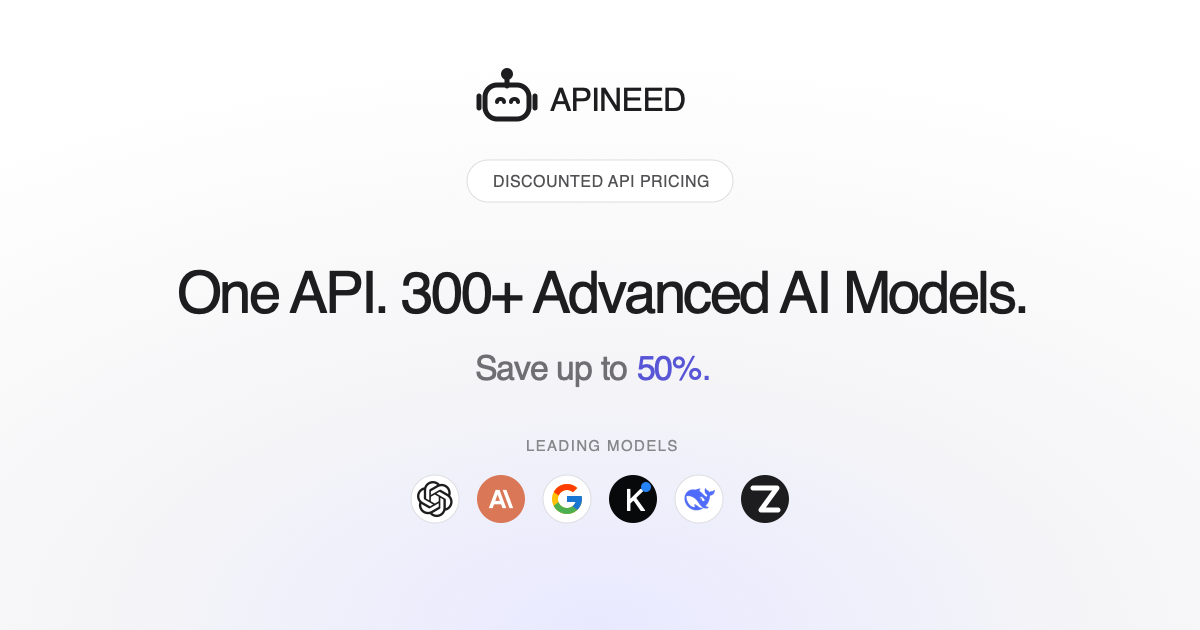
APINEED
APINEED offers one API key and usage-based pricing for AI model and tool APIs, covering 31 text, 2 video, and 8 image models plus agent tools.
Decision summary
Overview
What is APINEED?
APINEED is an API aggregation platform described as offering "Every API for AI agents" with "current prices, one API key, pay for what you use." It groups model APIs and tool APIs under a single account, API key, and balance, aimed at developers and agent workflows that call multiple AI services. The homepage lists 31 text models, 2 video models, 8 image models, and 4 agent tool collections currently available from the live API. It also provides navigation for Models, Tools, Playground, Sign up, and Get API Key.
How APINEED works
The page outlines a three-step quick start. Users first top up by adding credits to their APINEED balance before sending production requests. Next, they create one APINEED API key for all model and tool APIs. Finally, they add that key to Claude Code, Codex, or any agent workflow. This makes APINEED a single access and billing layer across separate model and tool APIs. Pricing is usage-based and can vary by model, token type, context length, output resolution, reference inputs, and request type. For some items, the page says additional pricing rules depend on the request and to check the quote before submitting.
Main features
- One API key: A single APINEED key is presented as usable across model APIs and tool APIs with the same balance.
- Usage-based billing: Users top up credits and pay for what they use; no subscription tiers are stated on the page.
- Text model APIs: 31 text models are listed, with examples such as glm-5.3, Gemini 3.7 Flash, claude-opus-5, kimi-k3, gpt-5.6-sol, gemini-3.1-pro-preview, and gpt-5.6-luna.
- Video model APIs: 2 video models are listed, including seedance-2.5 and seedance-2.0.
- Image model APIs: 8 image models are listed, including gemini-3.1-flash-image-preview-token, seedream-5.0-pro, and gpt-image-2.
- Agent tools: 4 tool collections use the same key and balance: Google Search API, Google Trends API, Google Maps API, and Google Places API, all labeled "by Apineed."
- Discounted pricing: Examples include 20% off glm-5.3, 50% off gemini-3.1-pro-preview, 95% off Google Search API, 87.5% off Google Trends API, 85% off Google Maps API, and 95% off Google Places API.
- Agent workflow integration: The quick start specifically names Claude Code, Codex, and agent workflows.
Pricing
APINEED uses usage-based pricing: top up credits and pay for what you use. No subscription fee, monthly plan, or free tier is stated. Prices are shown per model and can include discounts. Examples include glm-5.3 by Z.AI at 20% off: input $1.4 to $1.12 per 1M tokens, output $4.4 to $3.52 per 1M tokens, cache read $0.26 to $0.208 per 1M tokens. Gemini 3.7 Flash by Google is usage-based: input $0.5625–$0.7875 per 1M tokens, output $2.8125–$3.9375 per 1M tokens, cache read $0.05625–$0.07875 per 1M tokens. gemini-3.1-pro-preview by Google is 50% off for input context tokens ≤ 200000: input $2 to $1 per 1M tokens, output $12 to $6 per 1M tokens, cache read $0.2 to $0.1 per 1M tokens. gpt-5.6-sol by OpenAI is usage-based; for input context tokens > 272000, input is $2–$4.2, output $7.5–$15.75, and cache read $0.2–$0.42 per 1M tokens. Video pricing includes seedance-2.0 by ByteDance: $4 to $2 per 1M video tokens for 4K without reference video, $7.7 to $3.85 for 1080p without reference video, and $4.7 to $2.35 for 1080p with reference video. Image pricing includes gemini-3.1-flash-image-preview-token by Google, seedream-5.0-pro by ByteDance, and gpt-image-2 by OpenAI, with rates varying by image tokens or output pixels. Agent tools are listed per request: Google Search $0.00125, Google Trends $0.003125, Google Maps $0.00375, and Google Places $0.00125. The page notes that additional pricing rules depend on the request and to check the quote before submitting.
Common use cases
APINEED is positioned for AI agents and developer workflows that need multiple API types. The quick start names Claude Code, Codex, and agents. Use cases implied by the page include calling text models for generation or reasoning, generating video and images, and using search, trends, maps, and places tools through one key and balance. The single API key and usage-based billing may suit teams that want consolidated access across providers. The Playground may support testing before production, though the page does not detail its features.
Limitations
The page does not state service-level agreements, uptime guarantees, rate limits, quotas, regional availability, security certifications, compliance coverage, data retention policies, or support terms. It does not describe a free tier, subscription plan, or enterprise agreement. No information is provided about latency, concurrency limits, or model version stability. Pricing is shown as current but can depend on request parameters. Some prices are ranges, and some models list conditions such as context token thresholds, output resolution, or reference video/image inputs. The page advises checking the quote before submitting for some additional pricing rules. Model availability is described as "currently available," and inventory could change. Not every listed model or tool shows an explicit price on the page.
Summary
APINEED presents itself as a single API key and usage-based billing layer for AI model and tool APIs for agents. It lists 31 text models, 2 video models, 8 image models, and 4 agent tool collections, with current discounted prices shown on the homepage. The quick start is top up, get an API key, and use it in Claude Code, Codex, or agent workflows. Its main limitations on the page are the absence of stated SLAs, rate limits, compliance details, and free or subscription pricing.
Reviews (0)
No reviews yet. Be the first to rate this product!
Score anatomy
The dimensions behind the editorial score, each with its judgment note. AI Readiness and GEO Score are platform assessments generated by AIGCLIST after submission.
Evidence check
Public claims about this tool, each tagged with a verification status and its cited source.
Decision desk
The questions most worth resolving before you rely on the product or visit its official site.
Continue exploring
More in Large Language Models (LLMs)
Published tools that share this product's primary category. They are discovery links, not editorial comparisons.



Dr7.ai is a medical AI platform offering three specialized models: CheXagent for chest X-ray radiology analysis, BiomedCLIP for medical image-text multimodal understanding, and Clinical Camel for healthcare dialogue. API access is advertised across product pages but the OpenAPI specification endpoint returns 404. A free tier and promotional Pro Plan are available, though standard pricing tiers are not disclosed and no independent benchmarks accompany any model.